Fox News made a rather shocking admission the other day, letting slip that they view their programming not as news, but as comparable to the “editorial page” of a newspaper. See for yourself:
“An increasing number of viewers are relying on Fox News for both news and opinion,” Fox News Senior VP Michael Clemente said in the statement, “and the average news consumer can certainly distinguishbetween the A-section of the newspaper and the editorial page, which is what our programming represents.
“So with all due respect to anyone who might still be confused about the difference between news reporting and vibrant opinion, my suggestion would be to talk about the stories and the facts rather than the attack the messenger.”
So there you have it. After all the years of Orwellian branding as “fair and balanced” and “we report, you decide” (code for “we report information to support what you’ve already decided”), Fox is finally being honest about its purpose: not to report the facts, but to report talking points that “balance out” any facts that make its viewers uncomfortable.
For an example of the Fox machine at work, watch this amazing (and disturbing) video showing how Beck, Hannity, and others transform a scientist's statement that "we all believe this long-term global warming trend is man-made" into a prediction of "decades of global cooling":
If you can't watch the video, here's a transcript of the important parts. First, the statement from the scientist, Dr. Mojib Latif:
What you see here is just the globally averaged temperature during the 20th century, and you can clearly identify the long-term warming trend, and we all believe that this long-term warming trend is anthropogenic in nature, is man made. However, you see a lot of fluctuations superimposed on this trend, inter-annual as Tim has pointed out, but also decadal.
Now people who know me, at least my German colleagues, know that I do a lot of media work. There is almost no day in the year when I am not called by some media person. And so they basically think about global warming as a kind of slowly evolving process, and monotonic process, so each year is warmer than the preceding year.
However, we all know there is variability, okay, and this variability may look like this [graph]... And the two of course superimpose. And the real evolution of say globally averaged temperature would look like this [graph]. And then you see right away that it may well happen that you enter a decade, or maybe even two, you know, when the temperature cools relative to the present levels, alright.
And then, I know what’s going to happen, you know. I will get millions of phone calls, you know, “what’s going on? Is global warming disappearing? Have you lied on us?" And therefore, this is the reason why we need to address this decadal prediction issue.
Latif's prediction did happen. His reference to "a decade, maybe even two when the temperature cools" was clearly a hypothetical used to illustrate a point, but here's how Glenn Beck interprets it:
The leading climate model guy that has just backed out and said, "yeah, sure, I was wrong… we’re going into 30 years of cooling right now. At least!"
And Sean Hannity:
One of Al Gore’s most prominent allies in this global warming hysterical movement has just pulled the rug out from under the former vice president, and now says the world more likely faces decades of global cooling!
What can be done about Fox News? Well, that's the subject for another post.
The children are going socialist! Perhaps they're hoping to become part of Obama’s secret socialist army? The President never should have been allowed to give that speech to school kids.Now they’re singing about important issues!
(These are the same kids who did “You Can Vote However You Like” back in 2008.Check it out!)
And “Party in the USA” is still a terrible song.
UPDATE (1:34) Check out these comments that people are leaving on the youtube video - they'll probably be taken down by Youtube soon, so you can only see them here. VERY disturbing what the opposition to Obama is turning into:
Mike4567able need to spar bullets to get rid of the VERMIN rat n*****s
briantelesh This is brainwashing like that seen with the Hitler Youth. These tactics and using our kids to push a socialist agenda is sad. The lyrics are filled with not wanting to pay the bills as it gets higher, deductible, etc - so who pays - Me a hardworking taxpayer. Hell no Stop Obama Care!
I made the "socialism" remark halfway in jest, but check out some of these comments from Youtube:
1. See what the left wing Demos have done for poorest children and their schoolslook and see for yourselves how our Government has helped these Children. Look at the schools they have to attend and see where true true racism lives in the politicians who use them to get their money and not do a damn thing for them. My God People wake up and see how they are USING YOU!!! THEY ARE NOT HELPING YOU....You are the ticket to their side showof agendas. MONEY IN THEIR POCKETS NOT YOURS..
2. OMG Can't you read between the lines...my god their using our youth. Does this not ring a bell with us? Wake Up America. Soon we will be throwing up a hand in the air and sing hail to the Obama...another bleak moment for the Communist New Network. Pray for Our Children stay on your knees for them...they are coming after your children next. This Health Care Bill is an over throw of our civil Liberties.
3. Am I in Cuba???
4. I went to high school, college and grad school. I had plenty of anthropology and history, including the 20th century. That includes Lenin's first notes in a coffeehouse and what became of it. THAT is why this scares the hell out of me.
5. Praise Dear Leader! When do the benevolent-smile posters start going up on every building?
This makes me physically ill. And they wonder why people don't trust the MSM!
6. All propaganda has to be popular and has to accommodate itself to the comprehension of the least intelligent of those whom it seeks to reach.
Adolf Hitler
7. Lovely. 10-year-old kids being brain-washed by the Obama cultists.
Maybe they'll follow up this health care reform tune with one about how the evil rich people should pay more taxes.
Check out this video from House Minority Whip Eric Cantor (R-VA):
To counter President Obama’s statement that health care reform will not “require” anyone to change the insurance they have, the video points to sections of the bill that contradict Obama’s statement repeats the word “require” over and over again:
But for legislation that lets you “keep what you have,” one word seems to stand out: Require.84 times.The Democrats’ health care bill “requires” a lot from Americans who have been promised they can “keep what they have.”
Note that nowhere in the video does anyone actually refute what President Obama says.Cantor never explicitly says that health care reform will require you to leave your private insurance plan and sign up for a government option.But he does insinuate it by asking questions.Nevermind that George W. Bush’s $1.2 trillion Medicare Prescription Drug and Modernization Act of 2003 (which Cantor voted for) uses a variant of the word “require” 533 times.
This is a time-honored strategy of political rhetoric.Ask questions, make insinuations, repeat the same falsehoods over and over, without ever saying anything of substance – it creates doubt in the public’s mind, while still allowing you to deny charges of “lying.”If someone points out that nowhere does the health care reform bill “require” you to drop your current insurance plan, Cantor can plausibly maintain, “I never said that it would,” while still convincing a sizeable portion of the public otherwise.
This is the preferred tactic not just of health insurance industry shills (like Cantor), but also of global warming deniers (like Cantor).
Case in point: the past week’s “blog science” war over tree rings.For most of you, this will be an introduction to the global warming “denialsphere” and a lesson in political deception.For some, it’s a layman’s explanation of old news.
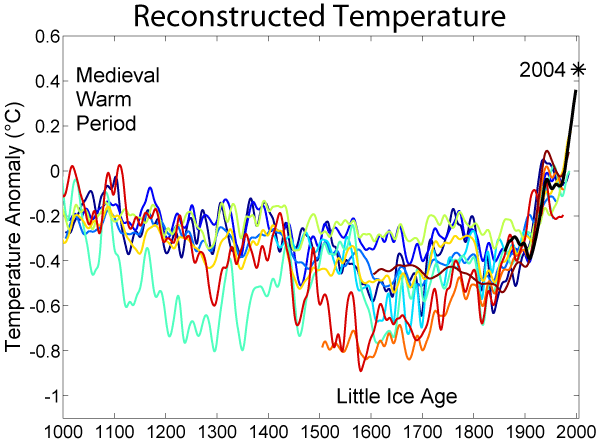
Here’s the story.Several studies have produced hockey stick-shaped graphs showing relatively steady global temperatures for 2,000 years, followed by a sharp uptick since the Industrial Revolution.Then, along came a non-scientist named Stephen McIntyre, whose discovery of a supposed flaw in one of these studies has led global warming deniers to use it as a straw man for discrediting all the others.The flaw was corrected, the shape of the graph didn’t fundamentally change, but that didn’t stop deniers from repeating their claims.For people who can only think in binaries, there’s no difference between “minor error” and “completely wrong.”
Now, McIntyre is back at the hockey stick, claiming that the tree ring proxies its authors used to estimate past temperatures were flawed.What do I mean by “proxy?”Well, for the past 150 or so years, we’ve been able to directly measure global temperatures with thermometers and other instruments, so we know what temperatures were.But further back than that, we don’t have reliable instrumental records, so we need to use “proxies” such as ice cores or tree rings to estimate what temperatures were.(A tree’s growth rings are thicker in warmer years and thinner during cooler years.)
One of these tree ring studies was by a scientist named Briffa, based on a series of trees from the remote Yamal Peninsula in Russia.McIntyre, a former executive in the oil and gas industry, decided to examine the Yamal tree ring record to see if he could spot any flaws.To seriously undermine the credibility of the hockey stick, McIntyre would logically have to show three things: #1, that the original dataset of tree rings does not accurately reflect past temperatures; #2, that an alternative dataset shows temperatures today to be not significantly different from past conditions; and #3, that the alternative dataset is, in fact, superior to the original.Could he do it?
On point #1, McIntyre offers little substance.He notes the “implausibly low” sample size, and then proceeds to ask a series of questions:
What was the basis for including the Avam site with Taimyr and not other sites in the area? What was the basis for including the Schweingruber Balschaya Kamenka with the Taimyr site and why wasn't its inclusion mentioned in Briffa et al 2008? Why was Balschaya Kamenka included, but not Schweingruber's AykaliRiver, Novaja Rieja, or KotuykaRiver? Why was Balschaya Kamenka included with Taimyr, while Schweingruber's KhadytaRiver, Yamal wasn't included with Yamal? And what effect did all these changes have on the resulting chronologies?
What he doesn’t do is offer any evidence of flaws in the actual data.What he does do is ask a bunch of questions to create the impression that we should doubt Briffa’s tree rings, without ever actually stating that there’s anything wrong with them.Like Eric Cantor, McIntyre is not a scientist.Like Cantor, he is good at the questioning technique.And like Cantor, he doesn’t actually say anything.
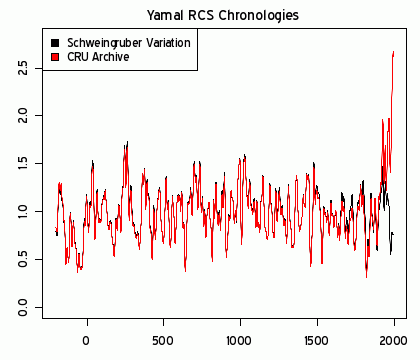
What about alternative datasets?If McIntyre can’t directly prove the hockey stick data wrong, maybe he can find a different set of tree rings that show different temperatures (point #2).And if he does, maybe he can explain why that dataset is superior (point #3).McIntyre does indeed find another set of tree rings, and when he substitutes them for Briffa’s, they do indeed produce a different result.McIntyre claims victory, insinuating that Briffa (who was ill with kidney disease at the time of the post) had intentionally and “disquietingly” cherry-picked tree rings to support his pre-existing conclusions. Here’s McIntyre’s graph:
Now I’m not a scientist (neither is McIntyre), but I do understand basic logic, and there’s an obvious problem with McIntyre’s graph.Notice that McIntyre’s data (the black line) is consistent with the original hockey stick (the red line), only diverging from the mid-20th Century on – precisely the years for which we have actual instrumental temperature records, and therefore don’t need to use proxies to estimate temperatures (check here for a zoomed-in look at the graph).Since the tree rings McIntyre used don’t match the actual temperatures recorded by thermometers, the appropriate conclusion is not that the hockey stick is wrong, but rather that McIntyre’s tree rings are not good proxies for temperatures.Logically, for a set of tree rings to prove the hockey stick wrong, they have to show higher temperatures in the past, not lower ones in the present, because the latter cannot, by definition, be used as temperature proxies.Poor Steve will just have to keep looking.
So we’re back where we started: McIntyre can show nothing wrong with the original data, and we know we can’t use his alternative dataset.Far from undermining the hockey stick, McIntyre’s claim actually reinforces it by proving that Briffa chose the most accurate set of tree rings.Even if McIntyre were right, there are countless other studies which show a hockey stick-shaped rise in temperatures; proving one wrong has no impact on global warming science.
What’s clear is that McIntyre and his ilk aren’t interested in actual debate over evidence, or even in proving global warming false – the strategy is simply to sow doubt.Tactic #1 is to set up straw men and tear them down, and claim that all climate science is similarly flawed; when even their attacks on straw men are proven false, continue to repeat them.Tactic #2 is to ask vague questions to create an atmosphere of doubt and suspicion; when those questions are in fact answered, continue to assert that the questions were never answered to make it look like scientists are hiding something.And when people get tired of repeatedly answering debunked claims, cry foul and proclaim your views are being suppressed.
And the media, the bastion of “fair and balanced” reporting, is all too happy to give McIntyre and his ilk a forum for voicing their delusions.A Daily Telegraph blog asserts that the “global warming industry is based on one MASSIVE lie.”(There’s a global warming “industry?”)Even the New York Times airs McIntyre’s grievances.Journalists, after all, are typically trained in journalism, not the underlying disciplines which they cover; the mechanism that should filter the trash from the truth doesn’t have the training to do so.And our democratic ideals of free speech and tolerance create an atmosphere where being “reasonable” requires giving all sides, no matter how demonstrably false, a fair share of the air.
The problem is, being reasonable is not the same as being right.Everyone has the right to their own opinions, but not to their own facts.At some point, we don’t need to give geo-centrists a counterpoint page.At some point, once the Truth is clear, stubborn skeptics should stop talking.
KEY TAKEAWAYS
(I’ll be including these in future global warming posts to summarize what can otherwise be a complicated and mathematical debate)
McIntyre never showed anything explicitly wrong with tree ring data that supports the “hockey stick.”He used a deceptive “questioning technique” to create the illusion of malfeasance, but offered no actual evidence.
The tree ring dataset McIntyre uses to create his critique of the hockey stick is bad data, since it can’t reproduce actual temperature measurements of the last 150 years.
Arguments against the “hockey stick” are straw men.There are several independent hockey stick graphs, so pointing out minor flaws in one doesn’t negate the others.
In my last post, I noted the curious phenomenon of conservatives cheering America’s loss of the 2016 Olympics. We've reached a point where any bad news for the country is a loss for the President – and hence something conservatives cheer.
But what do Friday’s jobs numbers actually tell us?When the media makes an announcement of “increasing job losses,” they’re comparing it only to the previous month – and I’ve explained before why it’s dangerous to make inferences from short-term trends.
Here’s what the job losses look like if you look only at this month and last:
Not good – a 30% jump in layoffs from August to September.But month-to-month comparisons are affected by statistical noise.To get a bigger picture of whether the stimulus is working, you need to look at the long-term trend:
On this timeframe, it’s clear that the trend since Obama became President is a steady decline in the rate of job-losses.Some months are worse than the trend, and others are better, but overall, it looks like the stimulus is working.And the bulk of the actual stimulus (government spending on infrastructure and clean energy) is only just starting to kick in.
For an even clearer picture, we can include some of the Bush years (apologies for the small graph - Blogger's interface for inserting graphics is poor at best):
Highlighting September 2009 and 2008 in red shows that we lost fewer jobs this year than the same month a year ago.Moreover, even before the collapse of Lehman Brothers in September of 2008, we were losing about 137,000 jobs a month under Bush.It’s taken President Obama just a few short months, but we’re almost back to that rate. At the current rate, we should expect layoffs to stabilize in about four months.And again, the full impact of the stimulus won’t be felt until 2010.No wonder Obama is so calm in the midst of the media hoopla and progressive hand-wringing.
Once again, don’t listen to news stories about short-term events – instead, pay attention to the long-term trends.
Despite the shouting and name-calling, our politicians and pundits earnestly want what’s best for the country; they merely have different ideas about how to achieve it.When President Obama’s fiercest opponents endlessly criticize him and obstruct his agenda, they’re doing it because they genuinely believe that his policies will make the country worse off, not out of petty desire for short-term political gain (or to protect powerful interests). If he had ideas they agreed with, they would support him. Right?
Let’s test that assumption by looking at an issue that’s not ideological at all: the Olympics.Unlike health care, where you can make a legitimate case that there are better and worse ways of improving the nation’s health (and whether that is even a legitimate outcome for government to pursue), the Olympics are unambiguous in terms of the desirability of the outcome and the means of achieving it. That is, we all agree that bringing the Olympics to Chicago would be a good thing for the country, and there is no debate over the means for doing that – you either bring them here or you don’t.
So how did Republican activists react to the news that our country had lost its bid to host the 2016 Olympics?See for yourself (the clip is from the conservative Americans for Prosperity’s Defending the American Dream Summit):
I mean, wow.A room full of Americans absolutely giddy that America lost its bid for the Olympics – or rather, giddy that the Olympic Committee delivered a loss to President Obama. And that's after Glenn Beck insinuated that the Olympics would lose Chicago $1 billion, and Republican Congressmen criticized the President for pitching the United States to the Olympic Committee. Seriously people, you don't have to stop liking the Olympics just because Obama likes them too.
We’ve thus come full circle since Rush Limbaugh’s infamous quip that he “hopes Obama fails”:
This isn’t the first time conservatives have called for their followers to inflict damage on the country out of spite for President Obama.Conservative radio hosts have, for instance, advocated a boycott of General Motors to ensure the company fails, knowing that a successful emergence from bankruptcy would be a victory for Obama (and more importantly, vindication of a greater role for government in the economy). Glenn Beck says that because Obama supports AmeriCorps, it must be a secret Nazi army. Michele Bachmann warns that the Census has been infiltrated by ACORN.
The smug giddiness over losing the Olympics only confirms the larger trend, showing just how fanatical opposition to Obama has become; for the most conservative of Republicans, it’s no longer principled opposition to specific policies – it’s a hope that the country itself will fail in order to vindicate conservative ideology. What scares die-hards the most isn’t that progressive policies will fail – it’s that they will succeed.Because that would prove liberalism correct after all.
Hence campaigns to destroy General Motors, to keep affordable health care out of the hands of millions of Americans, and even to oppose bringing the Olympics to the US. If the country must burn to prove an ideology – even if the flames are deliberately set by the ideology’s defenders – then so be it. The ability to never change your mind comes at a high price.
And congratulations to Rio for becoming the first South American country to host the Olympics.I’m not going to cheer my own country’s defeat, but I’m happy for another part of the world having its chance to shine.
*Note* Does anyone have video editing skills? It’d be great to create a mash-up of the Rush Limbaugh clip and the one of the people cheering over the Olympic decision.Leave a comment with contact info if you know how to do that.
George Will had another terriblearticle in yesterday’s Washington Post that repeated the myth that there’s been global cooling since 1998.Apparently Will hasn’t read my post on the subject.
But Will’s worst sin isn’t his recycling of repeatedly-debunked lies about global warming science – it’s this passage right here:
The U.S. goal is an 80 percent reduction by 2050. But Steven Hayward of the American Enterprise Institute says that would require reducing greenhouse gas emissions to the 1910 level. On a per capita basis, it would mean emissions approximately equal to those in 1875.
That will not happen. So, we are doomed. So, why try?
Reminds me of Homer Simpson saying "Kids, you tried your best and you failed miserably. The lesson is, never try." Conservatism truly is, by definition, a failure of imagination.
Self-taught William Kamkwamba has been feted by climate change campaigners like Al Gore and business leaders the world over.
His against-all-odds achievements are all the more remarkable considering he was forced to quit school aged 14 because his family could no longer afford the $80-a-year (£50) fees.
When he returned to his parents' small plot of farmland in the central Malawian village of Masitala, his future seemed limited.
But this was not another tale of African potential thwarted by poverty.
The teenager had a dream of bringing electricity and running water to his village.
Many, including my mother, thought I was going crazy - people thought I was smoking marijuana.
And he was not prepared to wait for politicians or aid groups to do it for him.
The need for action was even greater in 2002 following one of Malawi's worst droughts, which killed thousands of people and left his family on the brink of starvation.
Unable to attend school, he kept up his education by using a local library.
Fascinated by science, his life changed one day when he picked up a tattered textbook and saw a picture of a windmill.
Mr Kamkwamba told the BBC News website: "I was very interested when I saw the windmill could make electricity and pump water.
"I thought: 'That could be a defence against hunger. Maybe I should build one for myself'."
When not helping his family farm maize, he plugged away at his prototype, working by the light of a paraffin lamp in the evenings.
But his ingenious project met blank looks in his community of about 200 people.
"Many, including my mother, thought I was going crazy," he recalls. "They had never seen a windmill before."
Neighbours were further perplexed at the youngster spending so much time scouring rubbish tips.
William Kamkwamba's achievements with wind energy show what one person, with an inspired idea, can do to tackle the crisis we face.
"People thought I was smoking marijuana," he said. "So I told them I was only making something for juju [magic].' Then they said: 'Ah, I see.'"
Mr Kamkwamba, who is now 22 years old, knocked together a turbine from spare bicycle parts, a tractor fan blade and an old shock absorber, and fashioned blades from plastic pipes, flattened by being held over a fire.
"I got a few electric shocks climbing that [windmill]," says Mr Kamkwamba, ruefully recalling his months of painstaking work.
The finished product - a 5-m (16-ft) tall blue-gum-tree wood tower, swaying in the breeze over Masitala - seemed little more than a quixotic tinkerer's folly.
But his neighbours' mirth turned to amazement when Mr Kamkwamba scrambled up the windmill and hooked a car light bulb to the turbine.
As the blades began to spin in the breeze, the bulb flickered to life and a crowd of astonished onlookers went wild.
Soon the whiz kid's 12-watt wonder was pumping power into his family's mud brick compound.
Out went the paraffin lanterns and in came light bulbs and a circuit breaker, made from nails and magnets off an old stereo speaker, and a light switch cobbled together from bicycle spokes and flip-flop rubber.
Before long, locals were queuing up to charge their mobile phones.
Mr Kamkwamba's story was sent hurtling through the blogosphere when a reporter from the Daily Times newspaper in Blantyre wrote an article about him in November 2006.
Meanwhile, he installed a solar-powered mechanical pump, donated by well-wishers, above a borehole, adding water storage tanks and bringing the first potable water source to the entire region around his village.
He upgraded his original windmill to 48-volts and anchored it in concrete after its wooden base was chewed away by termites.
Then he built a new windmill, dubbed the Green Machine, which turned a water pump to irrigate his family's field.
Before long, visitors were traipsing from miles around to gawp at the boy prodigy's magetsi a mphepo - "electric wind".
While George Will asks, “Why try?” 22-year-old William Kamkwamba asked “Why not?”Opponents of climate legislation say the costs will be too high, the technology isn’t here, that we can’t do it.The GOP isn’t just the party of “NO” – they’re the party of “CAN’T.”
But Kamkwamba's story shows us what happens when we don’t limit our imagination of what’s possible by what our current experience tells us.We don’t need juju to solve the climate crisis – just a little guts, youthful creativity, and silence from defeatists like George Will.In the words of our great President…
The public option is looking more in trouble by the day – just yesterday, it was rejected by the Senate Finance Committee – which means I need to hurry up and get in the rest of what I wanted to say about health care.In particular, I wanted to finish eviscerating the quagmire of absurd arguments against the public option before it’s all over and everyone stops caring.
We’ve all heard the fuss over a “government takeover of healthcare,” which, as I’ve explained before, makes no sense.The public option is just that: an option.The government adding itself to the list of insurance providers can only provide more choice, not less.
The Senators must have been reading my blog, because I haven’t heard much of the “public option equals government takeover” argument of late.Now, the argument is more subtle.The public option would not be a government takeover today, but rather would lead to a takeover down the road by running private insurers out of business – in the words of Sen. Orin Hatch, the public option is “a Trojan horse for a single-payer system.”
Of course, this raises a serious question – or rather two.First, would it really lead to a single-payer system (government option is the only choice)?And second, even if it did, why would that necessarily be a bad thing?
Coming from a capitalist, the first argument makes little sense.If the market always produces the best solution, and the government is always inefficient and corrupt, how could a government run health insurance scheme run the supposedly superior firms out of business?The “magic of the market” is that the better option always wins.
Opponents of reform counter that the government would compete unfairly, allowing the government program to undercut private insurers on price.Of all the premiums private insurers collect, 15-25% go to sales and marketing and administrative costs – after all, they have to pay actuaries to estimate customers’ health risks so they can figure out how much to charge and who to exclude.These costs would be unnecessary for the government program.And of course, private insurers also need room for profits.In other words, government competition would be unfair because it can provide better service at a lower cost.
The obvious question at this point is, why is that a bad thing?
In fact, health care economics suggests that a single-payer government program should be the only option.Insurance works by pooling risk – there’s no money selling insurance to sick people, but if you pool enough people together paying premiums, most of whom are NOT sick, the healthy people essentially fund the sick.The more people you have in a risk pool, the lower the chance that a catastrophe to any one person will threaten the solvency of the overall pool, and the lower premiums you can charge.
Now, you may counter that all industries benefit from scale.Wouldn’t this argument justify the government taking over all industries?That WOULD be socialist!
Well, no.Unlike industries that transform raw materials into finished goods, profitability in the insurance industry is not technology-driven.Insurance companies are in the business of math – estimating and betting on risk.Whereas a factory can invent technologies that allow it to produce more stuff at lower cost, there’s no technology that enables you to squeeze another unit of math out of a dollar of cost.
If the goal is to provide as many people as possible with access to health care, there are only two ways to increase the amount of coverage you can provide for a given premium: reduce overhead costs or increase the size of the risk pool.
A single-payer system wins on both counts.A government program whose goal was to cover everyone would not have to hire actuaries to figure out who was too risky to cover, nor would a single-payer system need sales and marketing.A single-payer system would also create the largest possible risk pool, achieving the highest economic efficiencies.Sure, you’d be paying for it in taxes, but because of these efficiencies, the amount of the tax would be less than what you (and your company) currently pay in insurance premiums; your take home pay would therefore increase by more than your taxes.
Reform opponents are caught in a catch-22.If they’re right about the absolute efficacy of markets, then private insurers will easily be able to reform themselves and out-compete any lumbering and inefficient government-provided option.But if opponents’ fears are founded, and the public option would inevitably run the private companies out of business, that begs the question – if private health insurance can’t provide the same or better service than the government at a given price, why should health insurance be a private industry in the first place?If the government option turned out to be better, well then there’s no reason to bemoan the demise of private insurance.And there’s even a safety value: if insurance companies were all driven out of business, and the government option grew inefficient and corrupt over time, some clever entrepreneur should inevitably emerge to take on the government and steal its customers, making a tidy profit.What this proves is that a government insurance program can never leave you worse off.
So why do “free market” conservatives oppose expanding people’s choice so vehemently?My thinking is that conservatives aren’t so much in favor of free markets as they are opposed to anything that would make existing businesses have to work harder to earn their keep.If you increase business’s costs or competition, that might actually force them to innovate, and that would be, well, CHANGE.
A Southern Baptist preacher's kid from Oklahoma, I currently do sales & marketing consulting in the DC area. I'd like to think I know something about messaging, and try to apply lessons from the business world to climate change, health care, and the affairs of state.





 Posts
Posts