Monday, April 26, 2010

Schlumberger CEO on climate change

I liked this quote (from an interview with the McKinsey Quarterly because it aligns well with what I've said before:

And then on climate change, our opinion—and it’s my opinion, this is a very personal thing—is that there is sufficient evidence of an increase in the level of emissions in the atmosphere to be concerned about the effect that it may have on the climate. But the science of climatology is by no means complete, and it is going to take a long time before we really know what the effect of these emissions is going to be. In the meantime, it is prudent and reasonable to try to reduce those emissions as much as we can.

Remember, that's not a hemp-wearing hippie talking. It’s not Al Gore, or Joe Romm, or any number of climate activists. It’s Andrew Gould, CEO of a $23 billion a year oil services company—a company with a vested interest in climate change not being real. If even he can admit that climate change is probably real, and that it makes sense to invest a small percentage of our wealth in averting its worst effects, surely even the most skeptical libertarian can admit that climate change may not be a hoax after all.

RELATED POSTS

Climate craps: global warming and uncertainty

Ending the use of coal overnight: new study shows it's possible

One of the common arguments against climate legislation is that clean energy technology just isn't ready yet. Most often, it's made to defend coal, and usually goes something like this: "Sure, maybe eventually we can replace coal, but right now that would be too expensive. For the next 50 years, we'll need to continue using coal at the same time we're developing cleaner alternative fuels."

This argument has always been illogical. Just because alternatives to coal are expensive now does not mean they always will be, and a major national push would soon bring down costs through economies of scale. But a new study goes even further, showing the "technology not there" argument to be not just illogical, but factually incorrect. In fact, the United States could replace nearly 100% of its coal-fired power generation--and do so almost overnight. How? With natural gas (which emits 50% less CO2 than coal). The Financial Times reports:

The shift from coal-fired generation to gas- fired generation sounds like something that would be lengthy and difficult to accomplish. But a new report by PFC Energy, the consultancy, indicates it is anything but. The report says US gas fired power plants average about 25 per cent utilisation, compared with 70-75 per cent for coal.

So operating existing plants at 72 per cent utilisation would theoretically increase gas demand by 30bn cubic feet per day - a rise of about 50 per cent - and displace almost all coal fired capacity. In doing so, carbon dioxide from the power sector would be cut 50 per cent, according to PFC.

Note that this is referring to existing power plants. In other words, we could completely eliminate the use of coal in this country without building hundreds of new power plants.

Also note that this is a recent development. Just three years ago, the idea of abundant natural gas replacing coal actually was ludicrous, and coal's defenders at least had a point. But that's no longer true. The difference is new technology that has unlocked previously out-of-reach shale gas formations such as the Marcellus Shale in Appalachia.

Providentially, much of the nation's most promising gas potential is in the very states where coal is currently strongest politically: West Virginia, Pennsylvania, and Ohio.


All of a sudden, coal miners who fear job losses from shutting down coal mines now could have gas fields in which to work. Looks like King Coal could have some competition for its most supportive Senators. (Indeed, last month The Hill reported that the natural gas lobby is "pushing new incentives to encourage utilities to switch from coal to natural gas, [and] in doing so, the sector is starting a lobbying fight with the coal industry." All I can say is, go get 'em boys.)

The bottom line: any time you hear someone say that the technology isn't there to switch from coal, you're being fed PR dog food. We don't have to wait for solar and wind costs to come down before abandoning coal, because natural gas is already cheap and abundant - and we can make the switch overnight. All that's needed is political will.

Friday, April 23, 2010

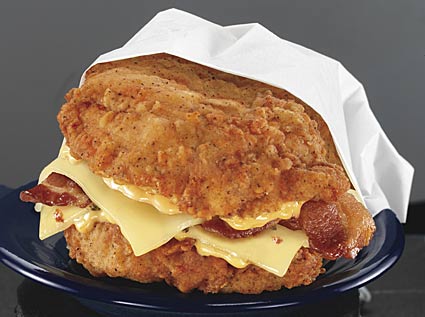
How do you take two pieces of fried chicken, cheese, bacon, and special sauce, and only get 550 calories? Deconstructing the Double Down

I flat out didn’t believe the Double Down’s calorie count. KFC claims the fried version of the sandwich has 550 calories, but intuitively, it just doesn’t seem to add up.

So this morning, I went online to see if the 550 figure was in the ballpark of believability. What I found surprised me.

The Double Down has four ingredients: two fried chicken filets, two slices of cheese, two strips of bacon, and “Colonel’s sauce,” which I’ll assume to be Thousand Island dressing. I’m not sure how big the chicken filets are, so to be conservative, I’m using “chicken strip.” Here’s how the calories add up:

Ingredient Calories

Chicken strip:                              117 (x 2)
Slice of cheese:                            94 (x 2)
Strip of bacon:                             46 (x 2)
1 tbsp Thousand Island Dressing: 31
_____________________________________________________
TOTAL                                          545

When I added it up, I was shocked. Just using nutrition facts I got on the internet, I came within 5 calories of KFC’s figure.

The key here is that Thousand Island dressing is actually a pretty low-calorie dressing. In my mental model, I was assuming 100 calories for the dressing—in retrospect, a major overestimate.

Now, the X-factor here is the size of the chicken filets. If they’re roughly the size of a chicken strip, I’ll believe KFC. If they’re much bigger though, KFC may have some accounting problems.

I’m getting a Double Down tonight though, so I’ll soon know.

If there’s a moral of the story, it’s that you should never assume your “common sense” assumptions are correct without testing the numbers. What you’ll find can often surprise you.

Tuesday, April 20, 2010

Goldman and Jay-Z: The allure of the game...

The allure of breakin the law
Is always too much for me to ever ignore
I gotta thing for them big body Benzes, it dulls my senses
In love with a V-Dub engine
Man I'm high off life, f*** it I'm wasted
Bey Venay kicks, or them Marvin Kaye wrists
My women friend get tennis bracelets
Trips to Venice, get they winters replaced with
the sun, it ain't even fun no more I'm jaded
Man, it's just a game, I just play it to play it…

I’m livin’ proof that crime do pay.

- Jay-Z, “Allure”

In news about another New York City institution:

Beset by accusations of securities fraud, Goldman Sachs nevertheless showed Tuesday that it was still very good at what it does best: making money.

Earnings for the Wall Street giant rose 91 percent in the first quarter of 2010, to $3.46 billion or $5.59 a share, up from $1.81 billion or $3.39 a share in the same period last year. Revenues increased 36 percent to $12.78 billion, up from $9.42 billion in the quarter a year ago.

Analysts surveyed by Bloomberg had expected revenue of $11.05 billion and earnings of $4.14 a share.

Monday, April 19, 2010

Quote of the Day

The mind-set of businesses has already changed. Businesses have accepted that they have to address climate change. In fact it seems that is much more accepted by business than it is by political leaders.
- Lars Josefsson, CEO of Vattenfall (one of the largest utilities in Europe), August 2000 - April 2010

Two weeks ago, I noted that anti-government rhetoric coming out of certain politicians in Washington seems yet to be lagging behind the thinking of the business leaders said politicians purport to support. Glad to see there are some CEOs out there who agree with me.

Thursday, April 15, 2010

Tax cuts are a bad sales pitch for Democrats

As a sales & marketing consultant, I have some advice for Democratic politicians: telling people how much you’ve cut their taxes is terrible salesmanship.

Sounds strange, right? The public hates taxes, and generally perceives Democrats as favoring higher taxes—so shouldn’t neutralizing that perception improve Democrats’ competitive position? Indeed, how could lowering taxes HURT a politician?

Simple: the key to effective selling is NOT explaining why you’re better than competitors at the thing the customer cares about—rather, effective selling means making the customer care about the thing you do better than the competition. For Democrats, as long as the public cares about lower taxes, hawking tax cuts plays to the other side’s competitive advantage. To win the tax issue, Democrats must reframe the debate to de-link “low taxes” from “good policy.”

Democratic officials, though, apparently don’t understand this basic marketing concept of differentiation. Instead, they are gleefully pushing an AP story which found that “Congress cut individuals' federal taxes for this year by about $173 billion shortly after President Barack Obama took office, dwarfing the $28.6 billion in increases by states”:

"The fact is in the past year we have had more tax cuts than almost anytime in our nation's history," said Rep. Steve Cohen, D-Tenn. "It's something that people don't realize because of the false rhetoric that is spread throughout this Congress.”


"From investing in small business to buying a home or making it energy efficient, to sending your children to college to buying a car, these tax cuts are helping families and businesses across the country," said Rep. Russ Carnahan, D-Mo.

Liberal bloggers like Steve Benen are picking up the theme as well. They wonder, Democrats are cutting taxes, so why isn’t the public giving them credit? To policy wonks, it’s an information: if Democrats can keep hitting the “we cut taxes too!” theme enough, the public will eventually pick up on it.

The problem is, this “me-too-manship” fails in politics as badly as in business. This is just like a B2B salesperson trying to compete on price. The sales rep does his best to understand what the customer is looking for, and designs a solution to meet that need. Unfortunately, competitors are asking the exact same questions and diagnosing the same needs. With every competitor designing its solution around the same set of needs, the final offerings all look alike. Price becomes the only perceptible difference, leaving salespeople to out-discount each other and destroy profits all around.

This is exactly the trap Democrats are falling into by promoting their tax cuts; the strategy can only result in a game of tax cut one upsmanship. Since Republicans are already perceived as the party of low taxes, a Republican can respond to any Democrat’s claims of tax cuts by saying, “I’ll do you one better.”

Instead of trying to outdo Republicans on their competitive advantage, Democrats need to reframe the debate—re-chalk the field, so to speak, around their competitive advantage. Since the public will never believe that Democrats will give them lower taxes than Republicans, Democrats should concede the point and sell the public on the value of the services their taxes are funding.

Here’s a sales pitch for Tax Day 2011:

Imagine a world without taxes. No roads and no bridges. No schools or teachers. No police, firefighters, or soldiers. This tax day, we want to thank all responsible Americans for their contributions that make life in society possible.

This pitch completely changes the goal posts of the tax debate. The winner isn’t the politician who can lower taxes the most, but rather who can provide the best services: Democrats’ competitive advantage. Taxes are no longer seen as an evil to be eliminated, but rather as the contribution responsible citizens make in return for the benefits of living in society. Indeed, lowering taxes TOO much would jeopardize society’s ability to function.

Is it risky? Sure. But that always beats a race to the bottom—whether you’re pitching products or policies.

Happy tax day! What are you thankful for?

Todd Flanders: Daddy, what do taxes pay for?
Ned Flanders: Oh, why, everything! Policemen, trees, sunshine! And lets not forget the folks who just don't feel like working, God bless 'em!

The tax man's taken all my dough,
And left me in my stately home,
Lazing on a sunny afternoon.
And I can't sail my yacht,
He's taken everything I've got,
All I've got's this sunny afternoon.
- The Kinks, "Sunny Afternoon"

If I were rich, I might hate paying taxes a little more. Until that day though, I'll be thankful for the subsidized buses that take me to work, the roads they drive on, the police officers who protect me from crime, the firefighters who will put out fires if my apartment burns down, the soldiers who protect my country from foreign invasion, and the teachers who gave me the education without which I never could have succeeded.

Oh, and also the refund check.


I like giving credit to the perpetually underrated but sneakily famous Kinks, but no tax day post could be complete without an homage to the most famous tax song of all time: